It is a good document. It is careful, it is specific, and it does something the agencies have mostly not done in public before: it names the problem out loud.
That alone makes it worth reading closely. The agencies that buy commercial Earth observation data have now written down, in a shared methodology, that the quality of that data is uneven enough to need a formal grading system. They published grades. And the grades are blunt in a way that press releases usually are not.
Read it a second time and what holds attention is not what the framework says. It is what kind of thing the framework is.
What they actually stated
The motivation the agencies give is straightforward. Cheap launch and a widening set of applications have produced a growing number of commercial EO satellite systems, and the agencies "agreed there was a need for an objective framework to assess the quality of data from commercial sources." CSDA's project manager, Dana Ostrenga, framed the guidelines as documenting "the rigorous standards we have for commercial data."
To see why that matters, you have to hold one fact about satellite imagery that is easy to miss: data from two different sensors is not comparable by default. A pixel value is not a physical measurement until something ties it to a known scale. Until then it is a number the instrument produced, and two instruments producing the same number does not mean they saw the same thing. Tying that number to a shared physical reference is the work of calibration and traceability, and it is the work that does not happen on its own.
The published assessments show exactly how uneven that work is across the commercial market. They are worth quoting because they are concrete.
Take BlackSky: The CSDA and ESA assessments found that BlackSky's imagery is delivered as raw digital numbers that are not radiometrically calibrated. The data is not surface reflectance. The documentation does not provide the radiometric calibration details, things like dark current and conversion factors, that you would need to turn those numbers into a measured physical quantity. On the joint quality scale, BlackSky's product information was graded "Basic."
Now take Satellogic, and look inside a single company. The CSDA report on Satellogic's NewSat constellation, issued in March, analyzed 60 top-of-atmosphere reflectance images collected between 2021 and 2025. The radiometric accuracy was generally good, with most spectral bands landing within ten percent of Aqua MODIS reference values. But the two sensor generations did not grade the same. The older Mark IV sensor earned an "Excellent" grade for its spatial response. The newer Mark V earned only a "Basic." Same vendor, same constellation, two generations of hardware, two different answers to the question of how good the data is.
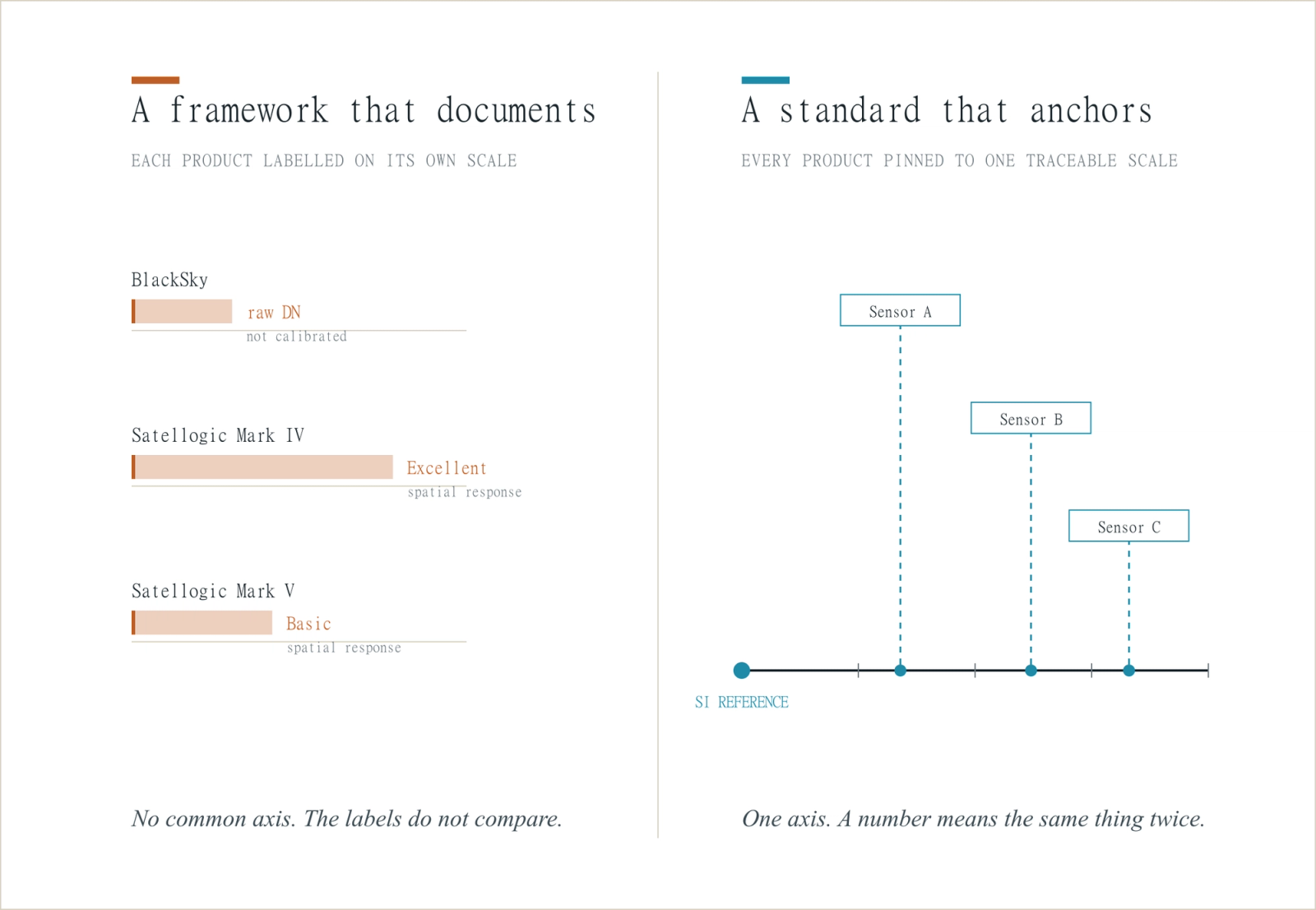
Figure 1 sets the two worlds side by side. On the left is what the framework gives you: each product carries a quality label, and the labels are real, BlackSky's raw digital numbers, Satellogic's Excellent Mark IV, its Basic Mark V. Follow the eye down the left column and the labels read cleanly. But look at the baselines under them. Each product sits on its own short axis. There is no shared scale running across all three. On the right is what a traceable standard does instead: it pins every product to one axis, anchored at a common physical reference, so a position on that axis means the same thing no matter which sensor produced it. The left panel grades. The right panel compares. The gap between them is the whole subject of this piece.
A framework is not a reference
Here is the distinction to be precise about:
A framework tells a buyer what to ask and how to read the answer. It is a way of documenting quality. The agencies have built a good one: it covers geometric and radiometric quality, validation against trusted reference datasets, the completeness and traceability of a vendor's documentation, and whether the data is actually usable. A buyer who works through it will know far more about what they are buying than a buyer who does not.
A reference is a different kind of thing. A reference is a fixed, traceable scale that every product can be measured against, so that two products can be compared on an equal basis because both are anchored to the same thing. A reference does not describe quality. It guarantees a common ground on which quality can be measured at all.
The April framework is, as its name would suggest, the first kind: it is advisory. It documents what each vendor delivers and grades it, but it does not ask any vendor to deliver to a single traceable scale, and it does not appoint anyone to own the uncertainty chain across the handoffs between who measures, who processes, and who decides. It tells users what to ask. It does not tell sellers what they should deliver.
None of this is to diminish the work. Documenting the gap honestly is genuinely useful, and the candour about BlackSky and about Satellogic's Mark V is more than the market usually gets. But documenting a gap and closing it are different jobs, and it is worth being clear-eyed about which one happened in April.
Why the difference bites
The reason the distinction is not academic is that the failure mode it leaves open is silent:
When you compare data from two sensors that are each graded on their own terms but not pinned to a common scale, nothing announces that the comparison is unsound. There is no error bar that flashes red. The numbers line up in a spreadsheet and look like measurements of the same world. The grade told you each product was, say, acceptable on its own terms. It did not tell you the two could be put side by side, because that was never what a grade was for.
This is where the consequences live. An emissions figure assembled from multiple commercial sources, a compliance finding that rests on a change detected between two sensors, a climate trend stitched across a constellation that swapped hardware generations partway through: in each case the decision treats the inputs as comparable measurements. The framework's own evidence says they may not be. Satellogic's Mark IV and Mark V are the same company's data, but they did not grade the same. The error does not surface when the data is collected or when it is graded. It surfaces, if it ever does, when a decision turns out to have rested on a comparison the data could not support.
That is the property that makes calibration uncertainty dangerous rather than merely inconvenient: It is invisible right up until the moment a decision depends on it, and by then it is downstream of everyone who could have caught it.
The picture that emerges
The picture is not that the agencies failed. It is that they did the parts they could do and stopped exactly at the edge of the part that is missing, which would be useful to users of such data.
They named the gap. They named it more precisely and more publicly than these documents usually do. And then they answered it with the only instrument an advisory body can issue: a document.
The framework exists, and it has real value, but it has no authority to require a common scale or to make anyone the custodian of the chain. The distance between the framework existing and it having that authority is not an administrative gap, it is the structural hole of data calibration, the one where no single party owns the uncertainty across the contractual handoffs, and it is exactly the hole that a fix has to be infrastructure to fill.
A framework that documents quality is a real step toward what the work is for: the grading, the validation, the candour. It is a step, and every party here takes the step it can reach. A data provider makes the best data they have available. A researcher documents the uncertainty. An agency grades against it and puts on the record that the gap is real. The part that is missing is the one no advisory document can supply on its own: pinning every product to one traceable scale, and giving someone ownership of the uncertainty across the handoffs.
That is a systemic failure: not of any party to this chain, but that the last step never gets taken, and nothing guarantees it will be. The agencies did their part, and did it well. What is missing is not a better framework; it is the next link, with no one responsible for forging it.
The agencies have now said, on the record, that the gap is there. The question their document cannot answer is the one that decides whether all this work reaches what it was for: who takes the scale, and the uncertainty that rides on it, the rest of the way?